Table of Contents
- Introduction
- Understanding Natural Veining in Marble
- Why Veining Matters in Architectural Design
- Types of Veining Patterns in Italian Marble
- Creating Statement Spaces with Veined Marble
- Enhancing Visual Depth and Texture
- Consistency vs. Natural Variation in Large Projects
- Practical Benefits for Builders and Designers
- Choosing the Right Supplier for Quality Marble
- Conclusion
- FAQs
1. Introduction
In modern architecture and interior design, materials are not just chosen for functionality—they are selected to tell a story. Natural stone, especially marble, plays a significant role in creating visually striking and luxurious spaces. One of the most distinctive features of marble is its natural veining.
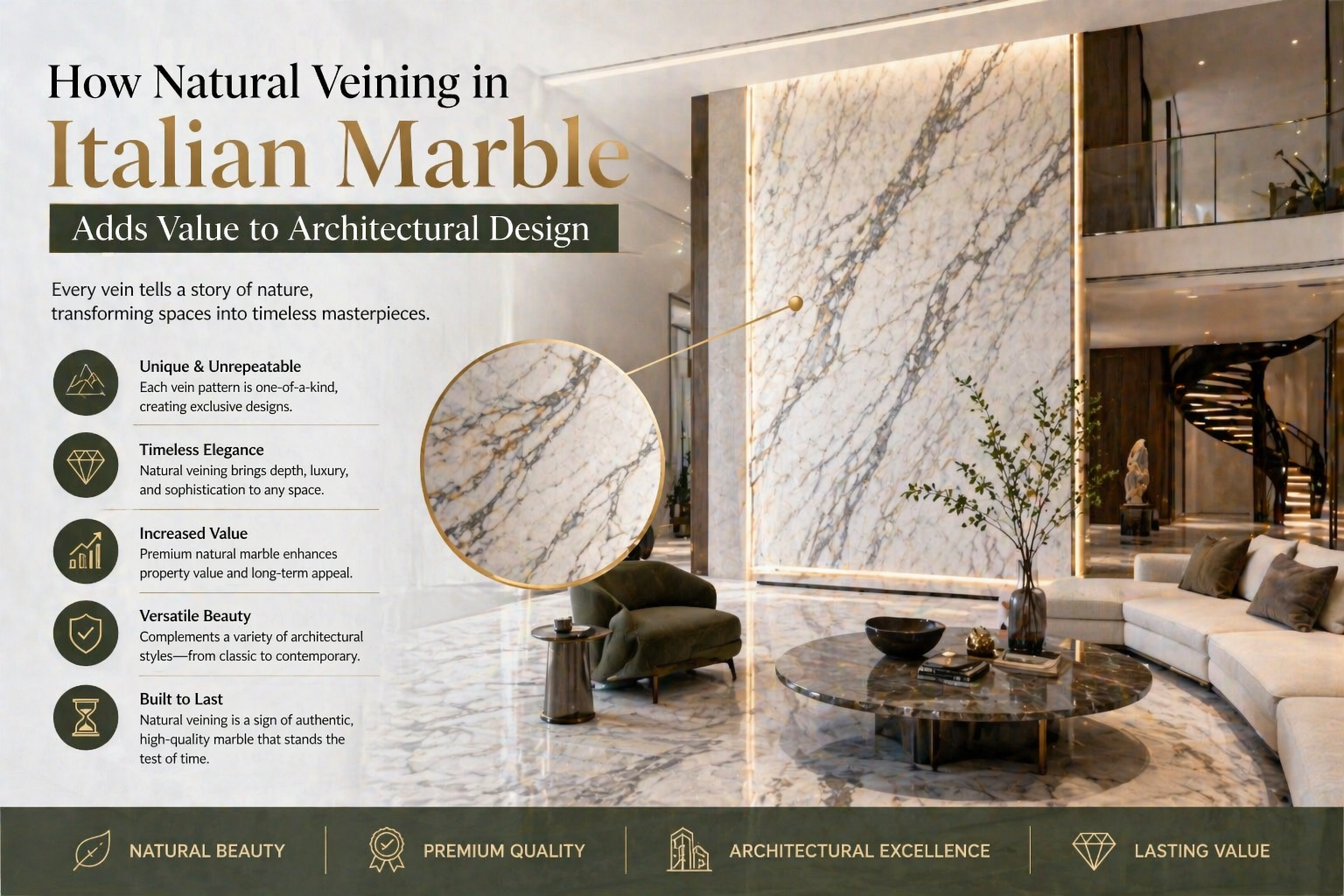
Italian marble is particularly admired for its elegant and unique vein patterns, which transform ordinary surfaces into artistic elements. In premium projects, Imported Italian marble is often chosen for its ability to add depth, character, and timeless beauty to architectural designs.
2. Understanding Natural Veining in Marble
Natural veining is formed over millions of years due to mineral deposits and geological processes. These veins appear as lines, waves, or patterns across the surface of the marble.
Each slab of marble is unique because:
- No two patterns are exactly the same
- Veins vary in thickness, direction, and intensity
- Colors range from subtle to bold contrasts
This uniqueness is what makes marble a preferred material for high-end design projects.
3. Why Veining Matters in Architectural Design
Veining is not just a visual feature—it is a key design element. Architects use it to:
- Create focal points in interiors
- Add movement and flow to surfaces
- Enhance the overall aesthetic appeal
- Introduce natural artistry into built spaces
Unlike uniform materials, marble’s natural patterns bring life and individuality to interiors, making each space feel exclusive.
4. Types of Veining Patterns in Italian Marble
Italian marble offers a wide variety of veining styles, allowing architects to choose patterns that suit their design vision.
Common types include:
- Linear Veining: Straight and subtle lines, ideal for minimalist designs
- Cloudy Patterns: Soft and diffused veins for a calm and elegant look
- Bold Veining: Dramatic patterns that create strong visual impact
- Feathered Veining: Fine, intricate lines that add texture
Neutral tones like Italian grey marble in India often feature balanced veining patterns that work well in modern interiors.
5. Creating Statement Spaces with Veined Marble
One of the most effective ways to use veined marble is in statement areas. These are spaces designed to capture attention and define the character of the interior.
Architects commonly use veined marble in:
- Feature walls in living rooms
- Grand entrance lobbies
- Reception areas
- Luxury bathrooms
Large-format Premium Italian marble slabs allow the natural veining to flow continuously across surfaces, creating dramatic and visually stunning effects.
Book-matching techniques, where slabs are mirrored to create symmetrical patterns, further enhance the impact of veining.
6. Enhancing Visual Depth and Texture
Natural veining adds depth and texture to flat surfaces, making interiors more dynamic and engaging. This is especially important in large spaces where plain surfaces may appear dull.
Benefits of veining include:
- Creating visual movement
- Breaking monotony in large areas
- Adding layers of detail
- Enhancing lighting effects through reflective surfaces
The interplay of light and shadow on veined marble surfaces creates a rich and luxurious ambiance.
7. Consistency vs. Natural Variation in Large Projects
While natural variation is one of marble’s greatest strengths, maintaining balance is important in large-scale projects. Too much variation can disrupt design consistency.
Builders and designers manage this by:
- Selecting slabs from the same batch
- Matching patterns carefully during installation
- Planning layouts in advance
This approach ensures that the natural beauty of marble is preserved while maintaining a cohesive design.
8. Practical Benefits for Builders and Designers
In addition to its aesthetic value, veined marble offers practical advantages for construction and design professionals.
Many experts prefer Italian marble for builders because it provides:
- Flexibility in design applications
- Easy customization through cutting and finishing
- High-quality surface polish
- Long-term durability
These features make it easier to achieve both creative and functional goals in architectural projects.
9. Choosing the Right Supplier for Quality Marble
The quality of veining and overall appearance of marble depends heavily on the supplier. Selecting a reliable supplier ensures that the marble meets both aesthetic and technical standards.
Working with the Best marble company in India ensures:
- Access to premium-quality marble
- Proper slab selection and grading
- Consistent batch availability
- Expert guidance for design and installation
A trusted supplier plays a key role in bringing architectural visions to life.
10. Conclusion
Natural veining in Italian marble is more than just a design feature—it is a defining element that adds value to architectural spaces. Its ability to create unique patterns, enhance visual depth, and transform interiors into works of art makes it an essential material in luxury design.
For architects and designers seeking to create distinctive and memorable spaces, Italian marble offers the perfect combination of beauty, versatility, and performance.
11. FAQs
Q1. What is natural veining in marble?
It is the pattern formed by mineral deposits within the stone, creating unique lines and textures.
Q2. Why is veining important in interior design?
It adds character, depth, and visual interest to surfaces.
Q3. Can veining patterns be controlled during installation?
While natural patterns cannot be changed, they can be arranged strategically for better visual impact.
Q4. Is veined marble suitable for modern interiors?
Yes, it complements both modern and traditional design styles.
Q5. How do architects use veined marble effectively?
They use it in feature walls, flooring, and focal areas to create statement designs.
Why Italian Marble is Ideal for Large Format Flooring Designs
How Italian Marble Helps Builders Achieve Premium Project Positioning