Table of Contents
- Introduction
- The Architect’s Perspective in Material Selection
- Aesthetic Superiority That Complements Design Vision
- Technical Reliability and Performance Standards
- Consistency in Large-Scale Architectural Applications
- Adaptability Across Design Styles and Spaces
- Long-Term Value and Lifecycle Benefits
- The Importance of Sourcing and Supplier Expertise
- Conclusion
- FAQs
1. Introduction
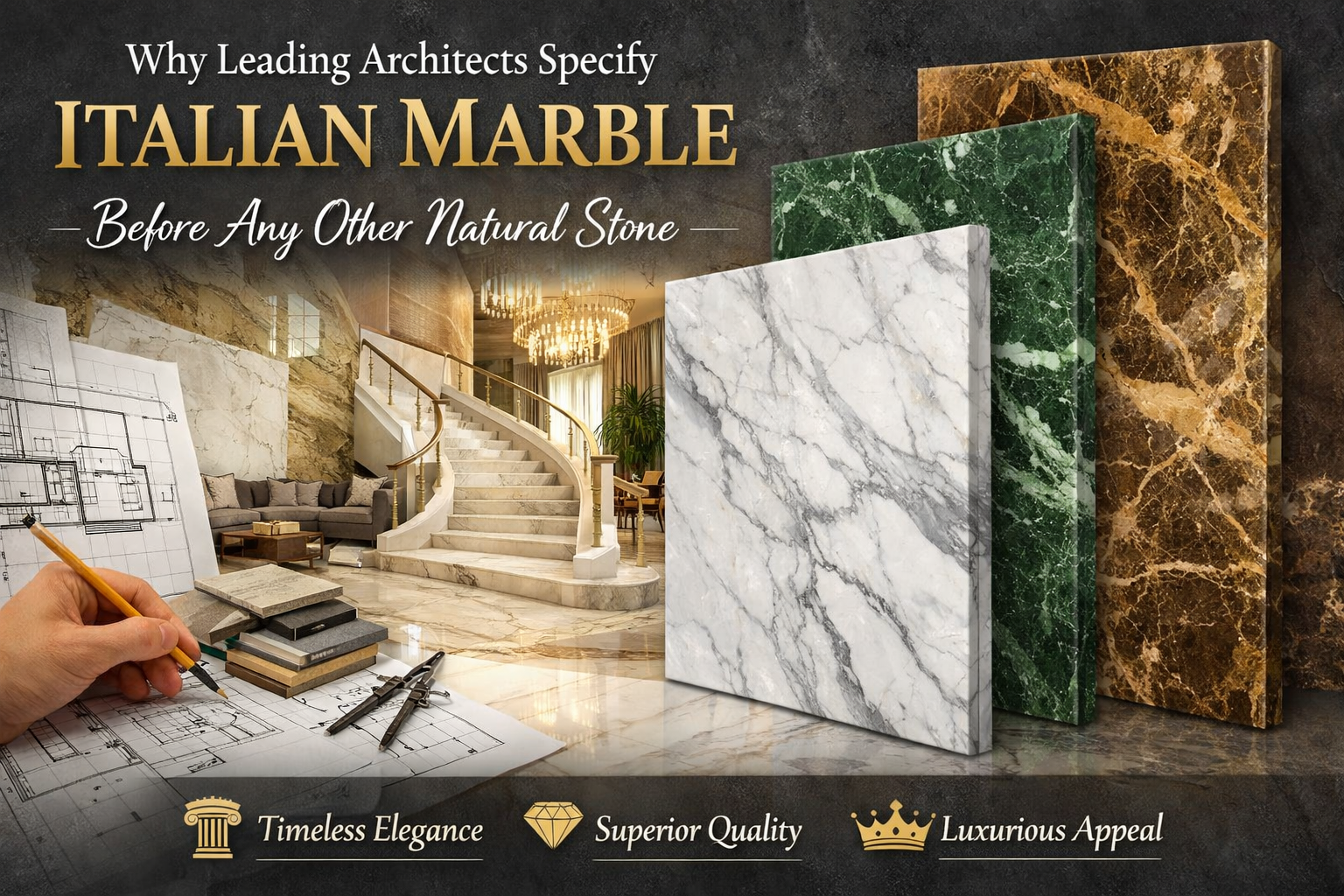
Architects carry the responsibility of balancing design intent, technical feasibility, client expectations, and long-term performance. Among all natural stones available in the market, Italian marble consistently earns priority in architectural specifications for premium projects. This preference is not merely driven by aesthetics but by a combination of reliability, consistency, and performance that supports architectural excellence.
This article explores why leading architects specify Italian marble before considering any other natural stone for luxury residential, commercial, and institutional developments.
2. The Architect’s Perspective in Material Selection
Architects evaluate materials based on several criteria:
- Visual harmony with the design concept
- Structural and surface performance
- Availability in required quantities
- Ease of application and finishing
- Long-term maintenance considerations
In this evaluation process, Imported Italian marble frequently emerges as the most balanced option, satisfying both creative and practical requirements.
3. Aesthetic Superiority That Complements Design Vision
Italian marble is globally recognized for its refined veining, subtle textures, and timeless color palette. These characteristics allow architects to create spaces that feel luxurious yet understated.
Unlike many stones that have unpredictable patterns, Italian marble offers elegant consistency, enabling designers to plan flooring layouts, wall cladding patterns, and book-matching effects with precision. This aesthetic reliability is a major reason architects prefer it for high-visibility areas such as entrances, living spaces, and lobbies.
4. Technical Reliability and Performance Standards
Beyond visual appeal, architects prioritize materials that meet performance standards. Italian marble is quarried and processed using advanced techniques that ensure:
- Strong compressive strength
- Controlled porosity
- Smooth finishing capability
- High polish retention
These characteristics make it suitable for both decorative and functional surfaces, ensuring that design intent does not compromise durability.
Neutral tones like Italian grey marble in India are often specified because they blend seamlessly with modern materials such as glass, metal, and wood while maintaining structural integrity in high-traffic areas.
5. Consistency in Large-Scale Architectural Applications
One of the biggest challenges architects face is maintaining uniformity across large project areas. Variations in stone color, thickness, or veining can disrupt the visual language of a design.
Italian marble solves this problem by offering:
- Batch consistency across slabs
- Availability in large sizes
- Predictable surface finish after polishing
The use of Premium Italian marble slabs allows architects to execute seamless designs in expansive spaces without worrying about mismatched patterns or inconsistent quality.
6. Adaptability Across Design Styles and Spaces
Architects work across diverse design languages—from classical luxury to minimal contemporary spaces. Italian marble’s versatility allows it to adapt effortlessly to different architectural themes.
It works equally well in:
- Modern luxury homes
- Corporate office interiors
- Hospitality environments
- Cultural and institutional spaces
This flexibility reduces the need to search for different materials for different spaces within the same project.
7. Long-Term Value and Lifecycle Benefits
Material selection also impacts the building’s lifecycle cost and value perception. Italian marble contributes to:
- Lower long-term maintenance requirements
- High durability under regular usage
- Enhanced property value and visual appeal over time
Because of these benefits, many professionals consider Italian marble for builders a smart investment that aligns architectural quality with financial prudence.
8. The Importance of Sourcing and Supplier Expertise
Even the finest material can underperform if not sourced correctly. Architects often emphasize working with trusted suppliers who understand grading, selection, and batch management.
Collaborating with the Best marble company in India ensures:
- Authentic material with proper specifications
- Assistance in slab selection and layout planning
- Reliable supply for phased construction
- Reduced project execution risks
Proper sourcing completes the chain between design intent and final execution.
9. Conclusion
Italian marble continues to be the first choice for leading architects because it fulfills the complete spectrum of architectural requirements—beauty, strength, consistency, versatility, and long-term value. It allows architects to confidently translate their vision into reality without compromising on performance or aesthetics.
In projects where precision and elegance matter equally, Italian marble stands ahead of other natural stones as a material that supports both creativity and construction excellence.
10. FAQs
Q1. Why do architects prefer Italian marble over other natural stones?
Because it offers a balance of aesthetic appeal, technical reliability, and consistent quality.
Q2. Is Italian marble suitable for modern architectural designs?
Yes, its neutral tones and elegant textures complement contemporary design elements.
Q3. How does Italian marble help in maintaining design consistency?
It provides uniform slabs with predictable veining and color patterns across large areas.
Q4. Does Italian marble require high maintenance?
With proper sealing and care, it requires minimal maintenance while retaining its finish.
Q5. Why is supplier selection important when specifying Italian marble?
A trusted supplier ensures correct grading, authentic sourcing, and uninterrupted availability for the project.

Italian Marble in Large-Scale B2B Projects: Performance, Consistency & ROI
Italian Marble vs Engineered Surfaces: A Technical Comparison for 2026 Projects